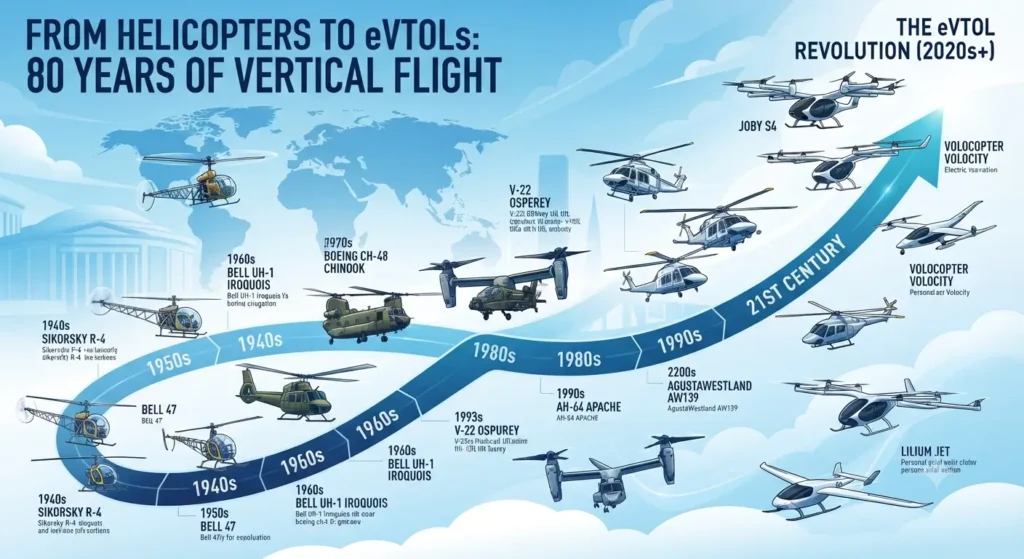
Every eVTOL company pitching investors right now is quietly re-solving problems the helicopter industry spent eighty years working through the first time.
Rotor icing. Vibration fatigue. Autorotation in a power-loss scenario. Noise certification that satisfies both regulators and the people living under the flight path. None of these are new problems. They’re the same problems Igor Sikorsky’s engineers ran into in the 1940s, dressed up in carbon fiber and lithium instead of aluminum and Avgas.
The difference this time isn’t the physics. It’s the constraints.
The Helicopter’s Original Constraint: One Point of Failure
A conventional helicopter survives on a single, spinning promise: as long as the rotor keeps turning, the aircraft can generate lift, even with the engine dead. That’s autorotation, and it’s the reason helicopters have a survivable answer to engine failure at all. It’s also why helicopter design spent decades converging on a small number of proven rotor and transmission architectures — there wasn’t much room to experiment when a transmission failure meant losing the one thing keeping the aircraft in controlled flight.
That single point of failure shaped everything downstream: strict maintenance intervals, expensive redundant hydraulics, and a certification process that treats the main rotor gearbox as the most scrutinized component on the aircraft.
The eVTOL Answer: Solve It With Redundancy, Not Perfection
eVTOL airframes mostly sidestep the autorotation problem by refusing to depend on one rotor at all. Distributed electric propulsion — six, eight, sometimes more independent rotors, each with its own motor and controller — means losing one unit doesn’t mean losing lift. It’s a different kind of safety case: instead of one flawless mechanical system, it’s enough redundant systems that the failure of any single one is survivable.
This is also why eVTOL companies can iterate on airframe design so much faster than helicopter manufacturers ever could. When no single component is a hard single point of failure, the certification conversation shifts from “how do we make this one part fail-proof” to “how do we prove the system tolerates failures” — a fundamentally different, and in some ways more flexible, engineering problem.
What Hasn’t Changed: The Rulebook Is Still Being Written in Real Time
Where the eVTOL industry is not getting an easier path is certification. The FAA and EASA are building new certification categories — powered-lift, in the FAA’s case — largely from scratch, in parallel with the aircraft themselves being designed. Helicopter certification had decades of accumulated precedent to draw on by the time any given manufacturer brought a new model to market. eVTOL manufacturers are negotiating the rulebook and the aircraft at the same time, which is a large part of why certification timelines have repeatedly slipped across the industry.
Noise is the other place the two eras genuinely diverge. Helicopters were, for most of their history, certified and sold with noise as a secondary concern behind performance. eVTOL air-taxi operators don’t have that luxury — vertiport placement in dense urban areas depends on community acceptance, and community acceptance depends on the aircraft being dramatically quieter than a helicopter at comparable altitude. Distributed propulsion happens to help here too: many smaller rotors spinning slower produce a different, generally less intrusive acoustic signature than one large rotor moving a lot of air fast.
The Throughline
None of this makes the eVTOL industry’s task easier than the helicopter industry’s was. It makes it different — a new set of constraints layered on top of the same underlying problem vertical flight has always posed: how do you keep an aircraft in the air, safely, without a runway.
That’s the throughline this publication exists to cover — not helicopters, not eVTOLs, but vertical flight as one continuous engineering problem that’s been getting re-solved, one generation of constraints at a time, for eighty years. The rotorcraft chapter isn’t ending. The next one is just starting to get written.