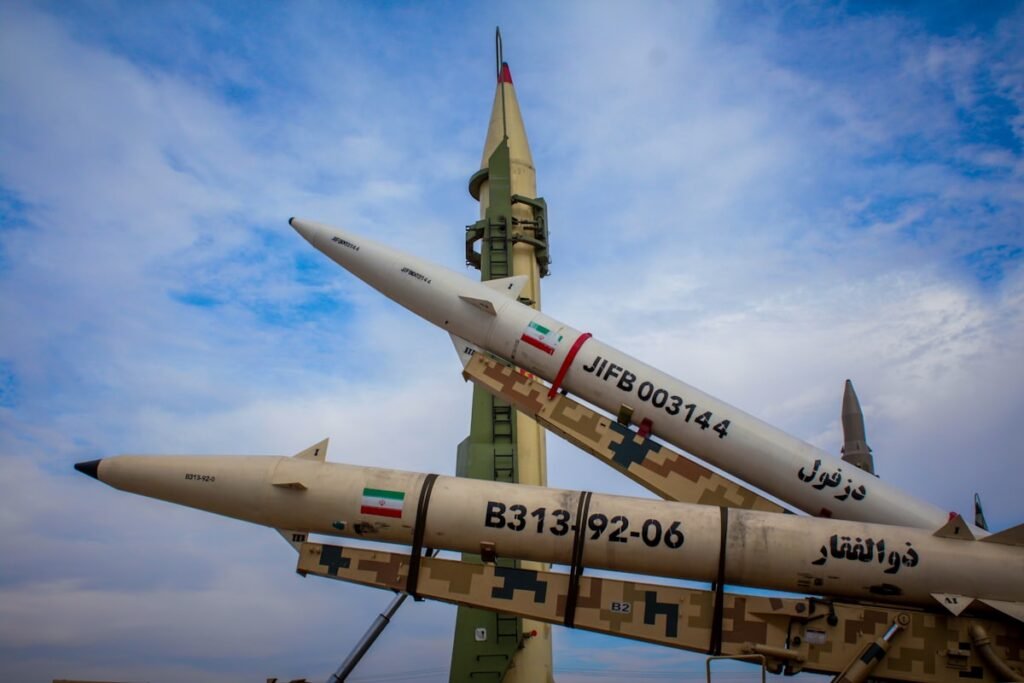
The strategic significance of Iran’s Shahed-series drones was never really about how technically sophisticated they are — by most measures, they aren’t especially. It’s about an economic imbalance: a Shahed can cost a small fraction of what it takes to shoot one down, and that gap is exactly what Iran’s drone doctrine was built to exploit.
The Doctrine Behind the Drone
Iran’s approach to the Shahed program didn’t emerge from nowhere — it’s the material expression of a strategic concept the IRGC’s Aerospace Force has developed since roughly the mid-2000s, rooted in a simple premise: unable to match American or allied conventional military superiority platform-for-platform, Iran has instead pursued systems that impose disproportionate costs on an adversary’s defensive infrastructure. Analysts covering the program describe this as “asymmetric cost imposition,” and argue the Shahed program embodies that logic more completely than Iran’s ballistic missile arsenal does — missiles are still expensive to produce even in large numbers; a Shahed is comparatively simple and cheap to build at scale.
Cheap to Launch, Expensive to Shoot Down
The tactical consequence of that doctrine is the “cost-exchange” problem that’s dominated recent discussion of the program: a defender facing a wave of Shahed drones has to choose between letting a cheap, slow-moving threat through, or expending an interceptor missile that can cost many multiples of the drone’s own price just to stop it. Scale that exchange across a sustained drone campaign, and the economics compound quickly — the defender’s ammunition budget depletes far faster than the attacker’s drone production costs, even if every single intercept attempt succeeds technically.
Multi-Axis Attacks Compound the Problem
Iranian drone operators have also demonstrated a more doctrinally sophisticated pattern than simple mass drone attacks in a single direction. Shaheds have reportedly been launched simultaneously from Iranian territory, from forward positions in Iraq via allied militias, and from maritime platforms in the Gulf — a multi-axis approach that forces a defender to maintain sensor coverage across a much wider radar geometry rather than concentrating detection assets toward a single expected threat direction. That complicates both the technical detection problem and the resourcing problem simultaneously: more sensor coverage required, spread across more potential approach vectors, against an attacker whose per-unit cost is already working against the defender’s economics.
The Response Taking Shape
The emerging counter to this isn’t a more expensive interceptor — it’s a cheaper one. Ukraine’s four years of sustained operational experience defending against Shahed and Shahed-derived drones (transferred to Russia and redesignated Geran-2) has produced a class of purpose-built, low-cost interceptor drones — often cited in the $2,000 to $5,000 range per unit — designed explicitly to fight the cost-exchange problem on its own terms rather than relying on traditional surface-to-air missile systems. That Ukrainian-developed counter-drone technology and doctrine is now being transferred to Gulf states and US Central Command, a direct acknowledgment that the previous generation of air defense systems, however technically capable, was never economically designed for this specific threat.
Why Traditional Air Defense Wasn’t Built for This
It’s worth being specific about why this caught sophisticated militaries off guard, rather than treating it as an obvious oversight. Air defense systems built over the preceding decades were designed against a different threat model entirely — fast, high-value manned aircraft and ballistic missiles, where a single successful intercept prevents a catastrophic loss, and where the attacker’s own per-unit cost is high enough that a defender’s expensive interceptor is still a reasonable trade. Loitering munitions invert that logic on both sides: slow, individually low-value, but arriving in numbers large enough that the defender’s ammunition supply, not just the technical intercept rate, becomes the binding constraint. A system that can shoot down 95 percent of an incoming wave can still lose the economic exchange if the 5 percent that get through are cheap enough that the attacker can simply send more, and if every interception costs the defender vastly more than the interceptor.
The Broader Lesson
What the Shahed program has actually demonstrated to militaries well beyond Iran and its immediate adversaries is that a numerically small, technologically unsophisticated but economically well-designed drone force can meaningfully strain even the most advanced air defense networks — not by defeating them technically, but by making every successful intercept a bad trade. That lesson is now visibly reshaping procurement priorities across the Gulf region and beyond, as the next section covers.